About $2.5tn was wiped off the value of the Nasdaq on Thursday 5 November as investors dumped technology stocks, CNN reported. The index fell 5.5%, its worst day since April 2025. Nvidia and SpaceX each lost roughly 9%.
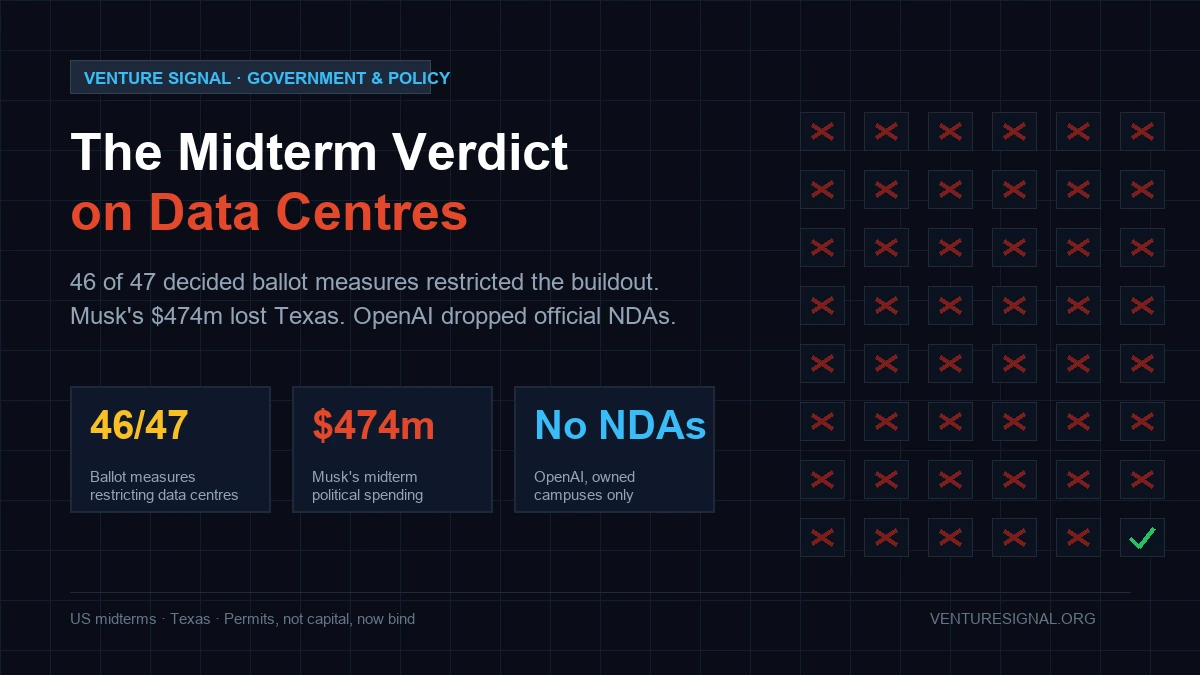
The trigger was political. Futures fell when the midterm results came in on Tuesday night and Wall Street rallied on Wednesday, but by Thursday investors were worried that Democrats, who won control of the House and the Senate, would use their leverage to tighten regulation and slow spending on AI infrastructure. In Texas, Democratic Governor-elect Gina Hinojosa campaigned on a temporary halt to new data-centre construction and on rolling back some tax incentives for the companies building them.
Asia and Europe on Friday
The selling reached Asia on Friday. South Korea’s Kospi and Japan’s Nikkei 225 both closed 6% lower and Taiwan’s Taiex 4.5% lower, according to CNN. In Europe the Stoxx 600 fell 1%, France’s CAC 40 0.8% and Germany’s DAX 1.9%. ASML, the Dutch chip-equipment maker, had fallen 6.6% on Thursday and was up 2.7% by Friday afternoon.
Wall Street steadied on Friday: the Nasdaq rose 1.1% and the S&P 500 0.3%, with Nvidia up 2.8% and SpaceX up 8.6%. The S&P 500 still ended the week about 2.7% lower, its worst week since April 2025.
Why the fall was so sharp
Leverage made it worse. Hedge funds and other investors who borrowed to bet on the AI boom faced demands for cash as prices fell, forcing more selling. Jamie Cox, managing partner at Harris Financial Group, told CNN the moves were “not indicative of a crash” and that the fund-driven selling could take a few more days to run its course.
What it means for founders and investors
The AI trade is now exposed to local politics as well as to earnings. Opposition to data centres was a midterm issue, and the first test is whether new capacity slows in states that changed hands. For start-ups that rent compute, slower construction means existing capacity stays expensive. For late-stage rounds priced against public AI stocks, a week like this resets the comparison.
Corrected on 12 November 2026: an earlier version of this article included figures and details that are not in the reporting it cited. They have been removed.