The US midterms did not just change who controls Congress. In dozens of local votes on 3 November, they changed the default answer to a data-centre application, and the largest developers are already rewriting their language in response.
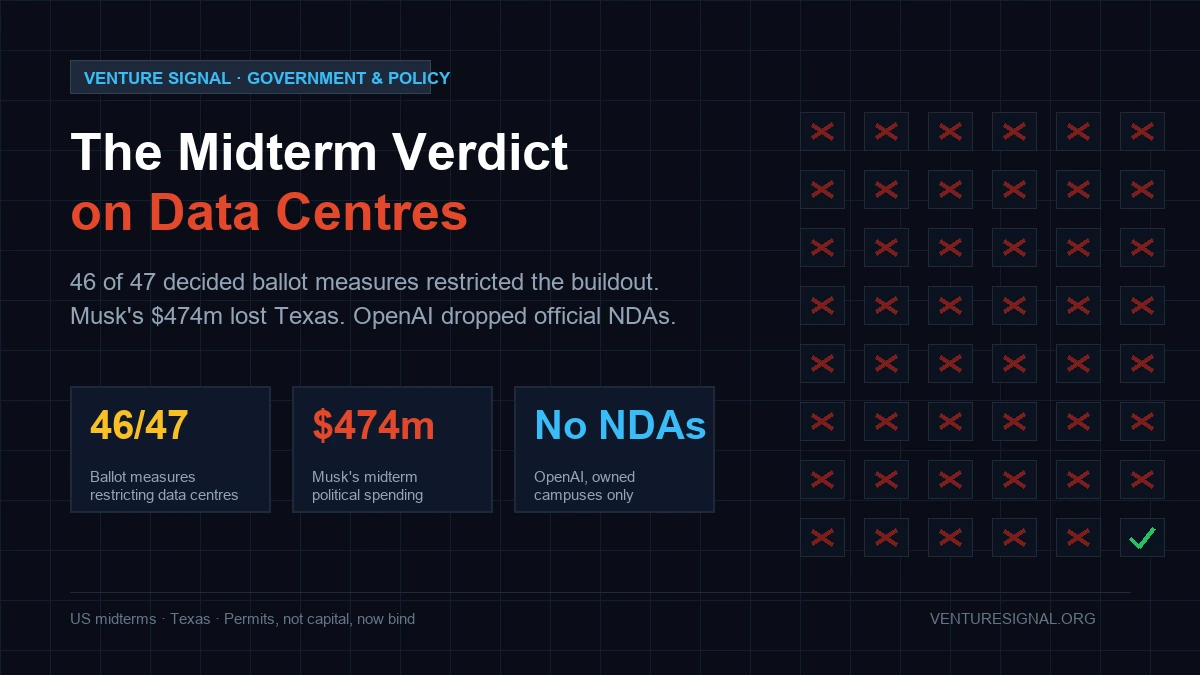
Ballotpedia’s count of decided 2026 data-centre measures, compiled by The Boston Report on 4 November, found that 46 of 47 limited data centres. In Texas, Democrat Gina Hinojosa defeated Greg Abbott after making the energy-hungry server warehouses a campaign issue, becoming the first Democratic governor of the state since the 1990s, the Associated Press projected. Abbott had already imposed a temporary moratorium on new approvals as the issue gained salience.
A local planning fight becomes a national one
Data-centre approval has been treated by developers as an engineering and legal exercise: find a willing county, sign the power deal, negotiate confidentiality where local politics is awkward. That worked while the issue stayed local. It no longer is. Meta’s president of global affairs, Dina Powell McCormick, conceded after the vote that big tech had failed to communicate tangible local value, a warning we covered on 6 November. When a hyperscaler’s own government-affairs chief says the industry lost the argument, the next approvals round starts from a deficit.
The ballots also showed the issue is not partisan in the way developers assumed. Water use, residential electricity bills and noise travel across party lines. Voters who rejected a data centre were not rejecting AI. They were rejecting a process that arrived with an NDA and a promise of tax revenue, and the burden of proof has moved to the developer.
Musk’s $474m concentrated the risk in Texas
Elon Musk was the cycle’s largest donor. The New York Times tallied $474m of political giving through 14 October, the most by any non-candidate donor in a single election cycle. Federal filings analysed by OpenSecrets put the total above $445m, with at least $225m directed at Texas, NPR reported.
Both candidates that money was meant to save lost. Republican Ken Paxton lost the Senate race to Democrat James Talarico, and Abbott lost the governorship. Democrats won every statewide office in Texas, NPR reported. That is an unusually concentrated bet for a businessman whose companies are headquartered in the state: Tesla runs its Giga Texas data centre in Austin, and SpaceX has been exploring Texas sites for large data centres, according to NPR.
The exposure now runs in two directions. A governor who campaigned on restricting data centres will shape permits and grid interconnects for the next four years, while a Democratic Congress has signalled it will examine federal contracts and the use of state influence. Political capital spent in one state does not transfer to a committee room in Washington.
OpenAI moves first, and only halfway
Two days after the vote, OpenAI published a National Community Compact and a Compute Campus Policy Blueprint. The compact commits the company, at campuses it owns and operates, to pay the full cost of the electricity and infrastructure it uses, publish site-level water and electricity data, report on local hiring, and stop requiring public officials to sign NDAs except for narrow security and trade-secret cases. OpenAI says it voided its Effingham County NDAs in July. The blueprint goes further, asking lawmakers to bar all developers from requiring official NDAs, mandate impact reporting and protect other utility customers if a project fails, CNBC and POLITICO reported.
The scope is the story. The commitments bind only the sites OpenAI owns and operates, not the partner-built capacity inside Stargate, and the blueprint is a proposal rather than a rule. The rebrand from data centres to “compute campuses” does not change a watt. A voluntary compact that covers only your own sites is a communications document until a regulator turns it into a licence condition. But it is also the first admission by a frontier lab that permission, not capital, is now the binding constraint on the buildout.
What it changes for founders and funds
Three practical consequences follow.
- Site selection is a political decision. Price six to twelve months of permit and interconnection risk into any US site. A county that voted for a restriction measure is not a neutral venue, whatever its zoning says.
- Community terms belong in the term sheet. Paying the full power cost, publishing water use and accepting a local compact are becoming the price of admission. Model them as operating costs, not public relations.
- Capital is available, but priced. OpenAI’s $11bn first close at a $1.25tn mark, reported by Bloomberg on 6 November, shows private money still clears for the frontier. What has changed is the discount applied to developers whose pipeline sits in one jurisdiction with a newly hostile statehouse.
The midterms did not stop the AI buildout. They moved its bottleneck. For two years the constraint was chips, then capital. For the next two it will be permits, and the companies that win will be the ones that learned to campaign locally before they applied.
Sources and primary documentation
- TechCrunch, 7 November 2026: After the midterms, things are looking rocky for Elon Musk and data centers
- The New York Times, 2 November 2026: Elon Musk Spends $474 Million on the 2026 Midterm Elections
- NPR, 4 November 2026: Elon Musk will face scrutiny from Democrats after midterms
- CBS Austin, 3 November 2026: Hinojosa defeats Abbott, becomes first Democratic Texas governor since 1995
- The Boston Report, 5 November 2026: OpenAI Ends NDAs With Officials After Voters Reject AI Data Centers (Ballotpedia data as of 4 November)
- OpenAI, 5 November 2026: Setting a new standard for responsible AI infrastructure and the Compute Campus Policy Blueprint
- CNBC, 5 November 2026: OpenAI releases new data center policy proposal after election rebuke
- Bloomberg, 6 November 2026: OpenAI Completes $11 Billion Portion of Funding at $1.25 Trillion Value