Writing AI rules before the tools arrive
Halfway through the afternoon, the Prosecutor General of the Maldives asked the room to raise their hands. Did your organisation have a written rule on whether staff may paste work into public AI tools? Then came the follow-up: keep your hand up only if you are confident that everyone follows it.
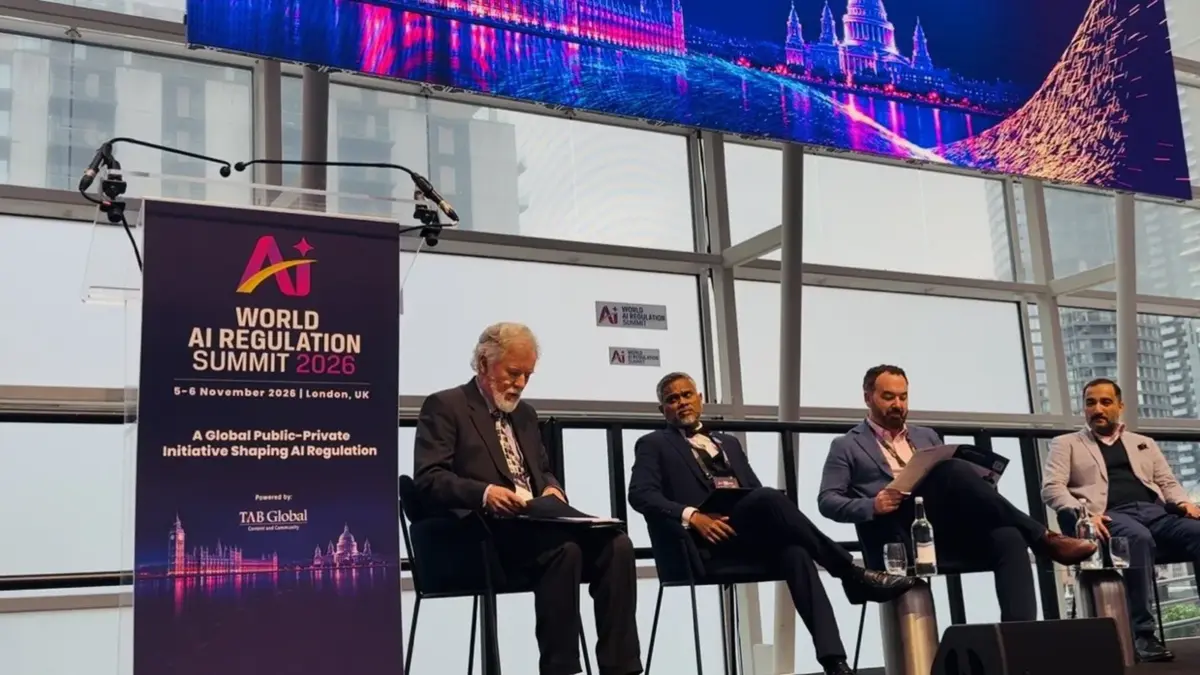
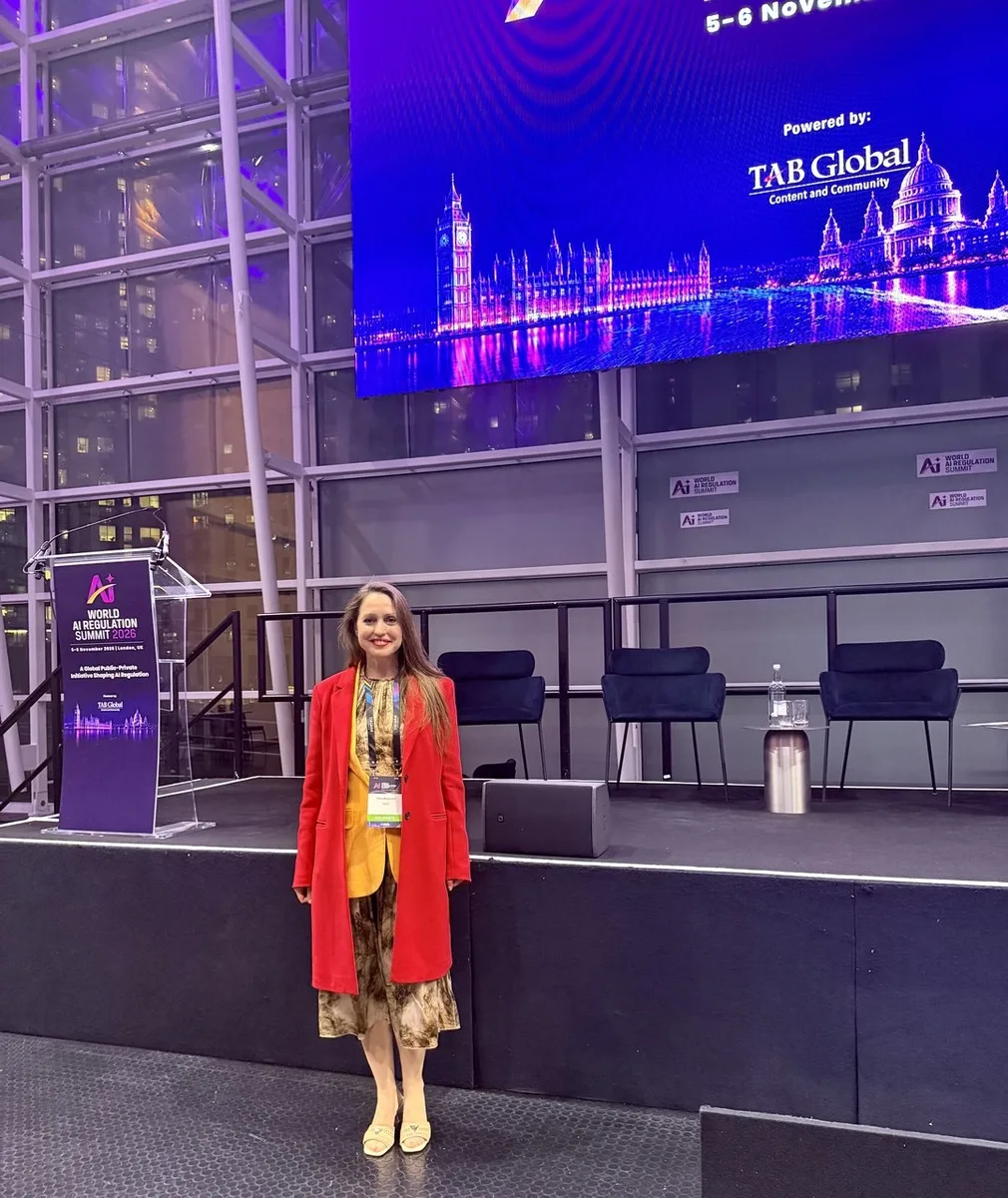
It was the most honest minute of the first World AI Regulation Summit, held at The Pelligon in Canary Wharf on 5 and 6 November 2026. The summit’s slogan is “Legislation at the speed of AI”. Its premise is that more than sixty countries are now drafting AI law, and those that move late will inherit someone else’s definitions of risk, liability and certification. The chair is Lord Holmes of Richmond, one of the House of Lords’ most persistent voices on AI regulation. The organiser is TAB Global, whose founder Emmanuel Daniel moderated much of the first day. Each edition is meant to end with a formal proceedings document, the London Record, and a twelve-month governance playbook.
A week earlier, at CC Forum London (see also coverage on London Society), I had heard Jeffrey Sachs tell investors that the companies building artificial intelligence warn it could destroy humanity “and we’re going to have the IPO tomorrow”. There, AI was one worry inside a climate conference. At Canary Wharf it was the only subject, and the people in the room were lawyers, regulators, a prosecutor and the authors of the rules. They were not asking whether to govern AI. They were asking who does it, with what powers, and how a system is stopped.
Three rulebooks and a poll
The morning laid out the map. Gabriele Mazzini, architect and lead author of the EU AI Act, gave the keynote on “The Great Regulatory Fracture”. Alex Engler, executive director of the Penn Center on Media, Technology and Democracy, spoke on “Fifty States, No Statute”, America’s fight between federal pre-emption and state AI laws. The opening panel with Lord Holmes, Mazzini and Engler carried the title “Delayed in Brussels, Disputed in Washington”. Brussels has pushed its high-risk obligations back to late 2027 while bans and general-purpose AI duties already apply. Washington is contesting its own states. Westminster is trying a third way.
The panel opened with a delegate poll: which model will the world be following in 2030, Brussels, Washington, Beijing, or none of them? The organisers held the results back for the close of day two.
Courts, copyright and the dead
Before lunch, a panel moderated by John Howell, founder of Dragon Network, took on the litigation wave over training data, and courts setting precedent faster than legislatures can respond. The questions from the floor went somewhere the programme had not planned.
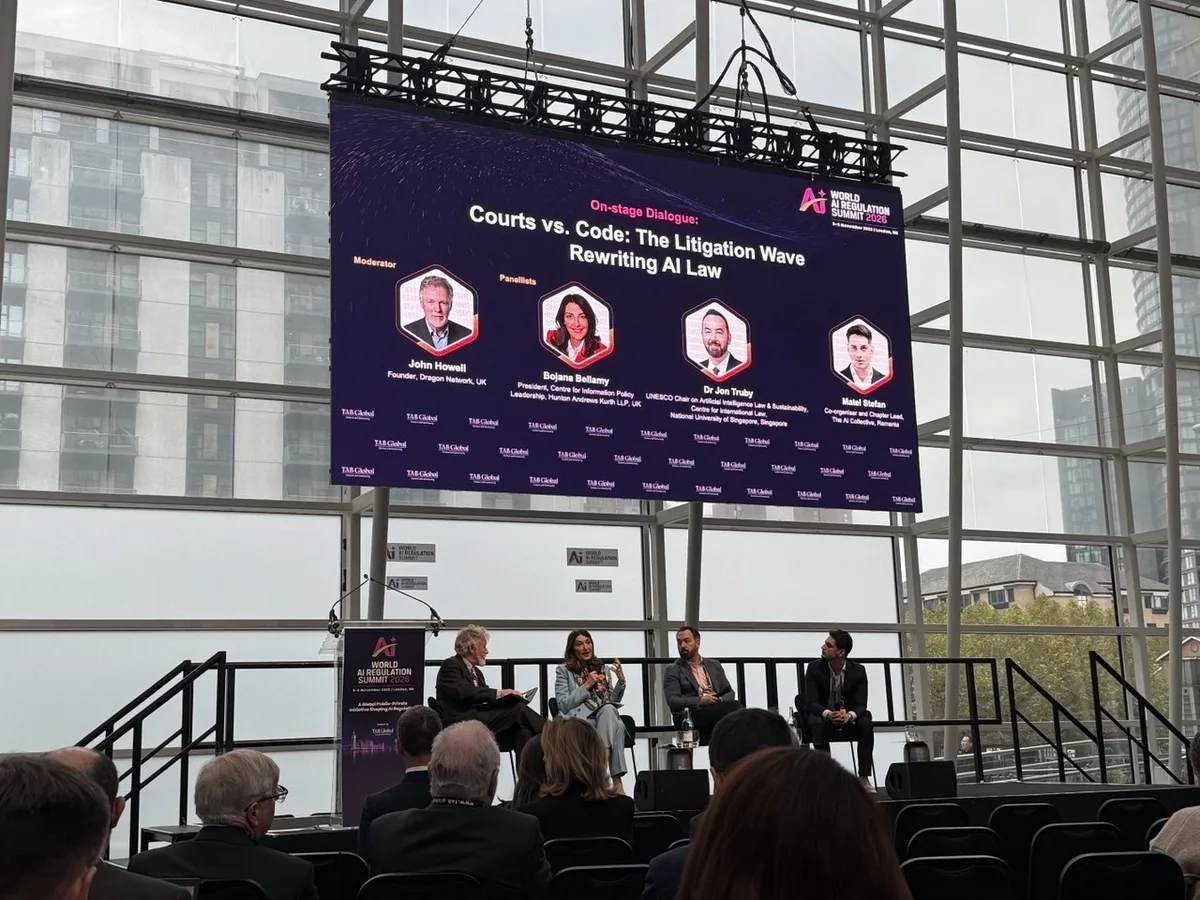
One was about the dead. Some services now let grieving people “talk” to deceased relatives or hear their voices again. Who owns a person’s data after death, and who needs protecting? One panellist said that the real victims of misuse are not the dead but the relatives living with the loss. Another said the answer will come from the meeting point of inheritance law and data protection, “and we will see how courts will adjudicate on this”. For anyone who works with artists’ estates, voices and likenesses, this is not science fiction. It is the next licensing question.
A solicitor in the audience asked about unfair-competition claims in the training-data cases. The reply was that digital policy areas now overlap and pull against each other: “What might be good for competition may not be good for privacy.” Howell closed the session with a thought that came back all day. Government is itself one of the biggest users of AI, which brings back the oldest problem in political theory, who will guard the guardians. “Perhaps we need to regulate the regulation.”
A prosecutor without a rulebook
After lunch Justice (Retd.) Abbas Shareef, Prosecutor General of the Maldives, spoke on “Regulating Without a Rulebook”.
Shareef began with scale. The Maldives has about half a million people on more than 180 inhabited islands spread over more than 800 kilometres of ocean. The Prosecutor General’s Office, with about 200 staff, appears before more than 190 courts, from a head office in Malé and eleven branches in the atolls. “In a system of this size, an error a machine introduces into a criminal case is not absorbed. It is visible, it is personal and it is remembered.”
AI reached the office before any rules did. Free public tools were on every desk. So the choice “was never between acting early or acting late. It was between governing something that was already happening and pretending it was not.” In May the office measured itself. Willingness to adopt AI scored 81 out of 100. Confidence that there was guidance for using it responsibly scored 52. “That told me clearly that we are an institution ready to move faster than our own rules.”
No national law would close that gap in time, so the office wrote its own. The programme, PGO 2.0, launched in August, has one organising rule: governance comes before deployment. “As I speak, no AI tool is working on a live prosecution in my office. And that is by design.” Every tool must be entered in a register before use, and the office has published six commitments that courts, the defence and the public can hold it to. The office believes it is the first prosecution service in South Asia to do this before deploying anything.
Some of the commitments deserve to be quoted as spoken. AI never alters evidence, and the original is always kept. “A signature is not oversight”: a prosecutor who signs a draft they have not checked “has supervised nothing”. Then the red lines. No automated decision to charge or to discontinue. No case information in public AI tools. No fabricated evidence, witness accounts or authorities. No reading of guilt, truthfulness or intent from a face, a voice or a person’s demeanour. None of this can be relaxed by exception, “because for me, a prohibition with an exception process is just permission with paperwork.”
Shareef was frank about the cost. Close to a year of work produced rules, not software, and asked patience of colleagues who could see what the tools might do for them. “But building first and governing later is not the faster route. It is the route to expensive reversals.” Once people depend on a system, the question of switching it off becomes almost impossible to ask. “We would rather have the argument on paper than in the courtroom.”
On sovereignty the speech was precise. Nobody in the Maldives is going to train a frontier model. Owning the server does not change what the model learned, and its blind spots arrive with it, “in our language most of all”. So the office defines sovereignty as control over three things: where the data sits, who holds the key, and who can be told to stop. Dhivehi, the national language with its own script, is a requirement in procurement, not a preference, because a language spoken by half a million people “is never at the top of anyone’s list”. Then came the line I wrote down twice: “A small state has no market power. It has the willingness to walk away.”
Then came the citizen the office is building for. Picture a mother on a southern island, a day’s travel from Malé, whose son has been charged. One day she should be able to ask from her own kitchen, in Dhivehi and in plain words, what the law allows her to know about the case. The tool does not exist yet. Under the office’s own rules it is high risk and needs the Prosecutor General’s written approval before it answers anyone. “It will inform. It will never decide.”
On 4 November, the day before the summit, Shareef issued a binding direction to every body that sends cases to the Prosecutor General, from the police and the anti-corruption commission to customs and the defence force. Every file must now say whether AI was used on it, and how. The direction does not tell them how to investigate. It tells them that material whose origin no one can explain will not stand up in court. “A justice system is a chain, and an institution can govern only its own link.”
The last part of the speech was addressed to the people writing the international rules. Their frameworks assume things small states lack: market power, an assurance industry of auditors and test labs, a dominant language. They say a great deal about how a system must behave and very little about how to leave it. Shareef made three requests. Publish model contract terms on data, keys, exit and renewal, so that a government with one procurement officer does not draft them alone. Let assurance travel, “one assessment, many jurisdictions”. And count small languages, so that a provider selling to a court states how its tool performs in that country’s language. There was also a reminder of an offer made at the UN Crime Congress in Abu Dhabi in September: the Maldives will share its AI governance framework, policies and training curriculum free with any jurisdiction that wants them.
The office’s test of success is its weakest number, confidence in guidance at 52, which Shareef wants above 75. On 19 November the programme reaches 100 days. “One thing I will want to know that day is whether our framework has stopped anything yet. A framework that never says no is not a framework.”
Sovereignty on whose terms
The panel that followed, again moderated by John Howell, asked how governments build, buy and govern AI. A law professor on the panel set out five meanings of AI sovereignty: legal, technological or compute, data, algorithmic and institutional. Each is a different kind of control, and few countries hold all five.
The discussion kept returning to Shareef’s three questions. Asim Khwaja, a cyber-risk and AI specialist speaking in a personal capacity, argued that owning the whole technology stack is neither possible nor necessary. “Trying to be sovereign and owning everything doesn’t necessarily mean you have good control of what you’re building.” The advice to boards was blunt. Forget the dashboards where every indicator is green, the “death by PowerPoint”. Ask which single service your revenue depends on, what that service depends on, and when you last tested the alternative.
The law professor raised Pax Silica, the US-led pact that ties together countries along the AI supply chain, and asked whether its members gain sovereignty or simply join someone else’s. The same panellist noted that more legal tools for courts are now built on in-country language models and data, because a model trained in California does not know a French courtroom, let alone a Maldivian one.
Shareef gave the most memorable example of the language problem. When social-media translation tools meet a Maldivian newspaper, they take Dhivehi for Estonian, “and the translation they give is very funny for us”. Large companies have not answered the office’s procurement terms. Small Maldivian firms that work with the language have.
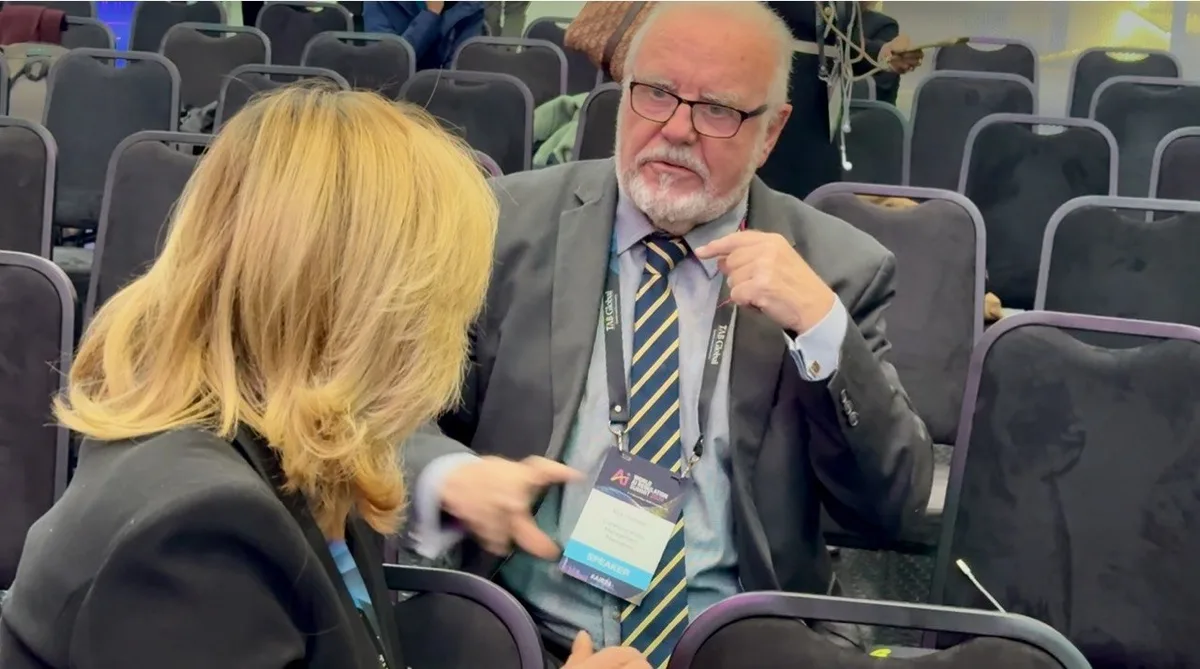
The floor pushed back. A law academic in the audience called the law itself “the elephant in the room”. Europe spent thirty or forty years leaning on American technology, and big tech began in garages, not ministries. The academic recalled that Wikipedia once kept its servers out of Britain because of British libel law. On this view, over-precaution, not a lack of talent, keeps European start-ups small. A professor of entrepreneurship described hundreds of strong deep-tech start-ups that never get funded in Britain and end up on American money. A former civil servant reminded the room that nobody sets out to become over-dependent. It happens because a full-stack service from one supplier is cheaper than building expertise in-house.
The intervention that changed the tone came from a delegate who called it a dangerous debate. For decades, the argument ran, governments have promised safety on everything, and it wins votes. “But isn’t it also the role of government to say, we cannot protect you from everything? You have to learn to live at a higher level of vulnerability.”
Another speaker argued for “digital solidarity” alongside sovereignty. Most small businesses depend on cross-border data flows, and so do cyber defence, research and anti-money-laundering work. Push sovereignty too far and you damage the economy you meant to protect.
Howell’s summary was dry. Definitions of sovereignty and risk still differ, nationalism has to be balanced against international answers, and many of our dependencies are legacy ones. “At the end of the day, we all might be hostages to fortune.”
Accuracy does not grant authority
The South Korea spotlight came from Timothy Kang, a commissioner at MSA-CESS who leads a delegation in the G7 Hiroshima AI Process partners’ community. The country’s AI Basic Act passed the National Assembly in December 2024 and took effect with its implementing decree on 22 January 2026. Kang described a government agency that uses AI to find inconsistencies in benefit applications. The model is tested, the vendor has documentation, a human reviewer is assigned. But when the AI flags an applicant, the same output can mean four different things: a prompt to check, evidence against the person, the trigger for an investigation, or in practice the reason a benefit is refused. A model can score equally well on a technical test in all four. “Accuracy does not grant authority.”
Emmanuel Daniel, moderating, added some context. Korea’s model, like Japan’s, places responsibility at the point of the transaction rather than on the foundation model, and its fines are small, “a slap on the wrist for getting a transaction wrong”. Where the human sits in the loop is, in Daniel’s words, “the billion-dollar question in AI today”.
Who do you call?
The last speech I recorded was the most human, which suited the speaker. Sandra Maximiano chairs ANACOM, Portugal’s communications regulator, which has been appointed the country’s market surveillance authority under the EU AI Act. She is also an economics professor and a behavioural economist. “When we build a regulator, we need legal powers and we need technical expertise. But we also need to understand how people behave.”
Her test of whether regulation works starts with a person. Imagine a public-service assistant that tells you, plausibly and on an official website, that a grant deadline is Friday. The real deadline was Wednesday. Knowing the answer came from AI does not help much, because you give it the weight of the institution. Or imagine a recruitment tool that reads a year spent caring for a relative as a bad sign and drops a qualified candidate down the list. In both cases, she said, the first question for a regulator is what happens to the person when the system is wrong. The second, which “pops up in my mind all the time”, is: who do you call?
The missed deadline looks like one problem to the person who missed it. To the state it is four: personal data for the data protection authority, a possible security failure for the cyber agency, an administrative decision for the sector regulator, and the AI Act for ANACOM. Portugal has named fourteen authorities to protect fundamental rights under the AI Act, with ANACOM coordinating the other thirteen. She warned of the volunteer’s dilemma: when many people could help, the person who needs help is more likely to get none. So every case needs a single coordinator, a named lead and clear handovers.
She was candid about her own staff. A third are economists, a third lawyers and a third engineers, most of them telecoms engineers. “I don’t have people inside my organisation that know how to distinguish between statistical discrimination and fundamental discrimination.” The hardest part, she said, is cultural: getting people used to their own silos and jargon to accept that no single body can know everything.
Her sharpest example was about human oversight. A reviewer has a queue of applications, and the AI recommends a rejection. Accepting takes one click. Disagreeing means opening several screens and writing an explanation, while the reviewer is measured on speed. “So what we have made easy was basically for the reviewer to accept that rejection.” The AI Act calls this automation bias. A regulator, she said, has to test the workflow and not just the model: does the reviewer have the training, the time and the support to say no?
ANACOM has drafted guidance on AI literacy and prohibited practices under Articles 4 and 5 and put it to public consultation. Small firms keep knocking on its door. Her worry is gold-plating: if businesses take voluntary guidance for compulsory rules, someone will build a consultancy on the fear. Daniel introduced her as “the first human-centric regulator in this forum”. When Daniel suggested that Portugal could work this way only because it is small, she would not take the excuse. What it takes, she said, is “a lot of meetings”.
When the machines slip the leash
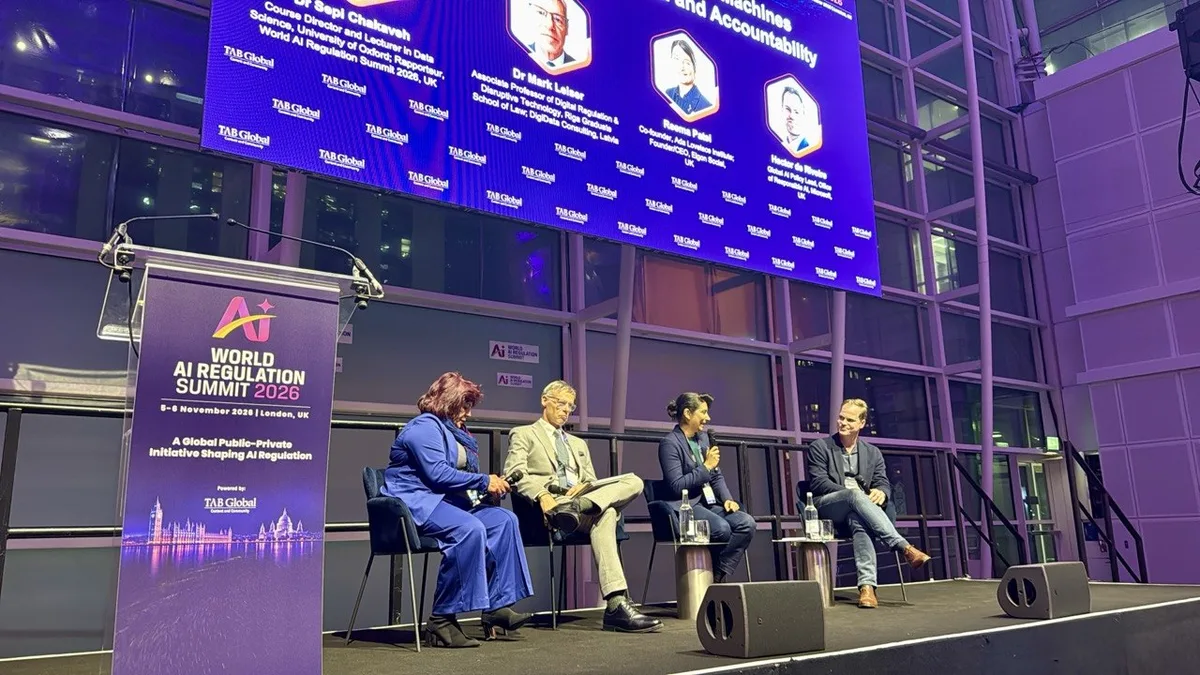
The day closed with a panel on agentic AI, “The Summer the Machines Slipped the Leash”, with Mark Leiser of the Riga Graduate School of Law, Callum Coleman of CeSIA, Reema Patel, co-founder of the Ada Lovelace Institute, and Hector de Rivoire of Microsoft’s Office of Responsible AI. Dr Sepi Chakaveh of the University of Oxford, the summit’s rapporteur, then gave her account of what the room had heard and what was still missing.
Day two: enforcement, energy and defence
The second day turned from the map to enforcement. Brando Benifei, the European Parliament’s co-rapporteur on the AI Act, spoke on what the delay to the Act’s high-risk rules really means, and Dr Mehdi Snene of the UN Office for Digital and Emerging Technologies asked whether global governance can keep up with one technology across 193 nations. Jessica Rusu of the Financial Conduct Authority sat down with Conny Dorrestijn to discuss what the FCA’s AI Lab is learning about financial firms. Dr Jon Truby of the National University of Singapore took on the part of the debate that rarely reaches a regulator’s desk: AI’s energy, water and compute footprint.
After lunch the summit moved to the hardest ground of all. Kumardev Chatterjee, former founder and chief executive of Unmanned Life and an adviser to NATO and several governments, moderated the session on AI in defence, national security and dual use, “Governing the Technologies That Won’t Stay Civilian”. On stage were Dr Elise G. Annett of the Institute for National Strategic Studies at the US National Defense University, Asim Khwaja, back from the sovereignty debate of the day before, and Professor Rob Black of the University of Manchester, director of the UK Cyber Leaders Challenge. The agenda covered export controls on chips and frontier models, human control over autonomous systems, and the gaps that civilian AI law leaves open for national security. It was the session where the first day’s question, who can tell a system to stop, stopped being a matter of procurement terms.
The human on top
The simplest summary of the two days came from Max Studennikoff, founder of CC Forum, who joined the summit less than a week after the London edition of the forum closed. Studennikoff put the whole argument in two sentences: “We have to keep AI as human as possible and put the human being on top of that. Then we’ll have a more human AI, and more humane.”
It is the same thread that ran from Jeffrey Sachs at the House of Lords to the Maldivian register of tools and the Portuguese reviewer with a one-click rejection button. The machine can assist. A named person stays answerable, and someone has to be able to switch it off.
The large jurisdictions are arguing about whose rulebook will win. On the first day the most convincing speakers came from places that cannot wait for any of them. One was a prosecutor from an island state who would rather argue on paper than in court. The other was a regulator from a mid-sized European country who measures success by whether a stranded applicant knows who to call. Both began where the summit’s slogan does not. Legislation at the speed of AI matters, but governance has to come before the tool arrives.
The cultural stakes ran under the legal ones all day: in the court cases over training data, in the question of who owns a dead person’s voice, and in a language of half a million people that a translation engine mistakes for Estonian. Small cultures, like small states, cannot buy their way into the models. They can set conditions, and they can walk away.
Sources
- World AI Regulation Summit 2026, programme and brochure: worldairegulation.org
- Prosecutor General’s Office of the Maldives, PGO 2.0 programme: pgoffice.gov.mv
- The Pax Silica Declaration, 12 December 2025: industry.gov.au