Nvidia reports its data-centre revenue in two groups. In the three months to 26 July 2026, revenue from hyperscalers, the largest cloud companies, was $48.7bn, up 13% on the previous quarter. Revenue from the second group, which Nvidia calls AI Clouds, Industrial and Enterprise, was $40.3bn, up 25%. The faster-growing group is the one that includes the smaller cloud operators Nvidia now supports with capacity agreements and guarantees.
That split explains why the departure of Jensen Huang matters for Nvidia’s revenue as well as its governance. The biggest buyers are designing chips of their own. The customers adding demand fastest are the ones that rely on Nvidia’s balance sheet.
The largest buyers have alternatives
Each of the three largest cloud companies now has its own accelerator, and the biggest AI developers are using them.
- Google. In October 2025 Anthropic said it would expand its use of Google Cloud TPUs to up to one million chips, in a deal worth tens of billions of dollars that would bring well over a gigawatt of capacity online in 2026. Anthropic said it would continue to use Amazon’s Trainium and Nvidia GPUs alongside. In February 2026 The Information reported that Meta had signed a multiyear deal to rent TPUs through Google Cloud; neither company commented.
- Amazon. AWS made its Trainium3 UltraServers generally available in December 2025, with up to 144 chips per system and, by AWS’s account, up to 4.4 times the compute of the previous generation. It said its Bedrock service was already running production workloads on them.
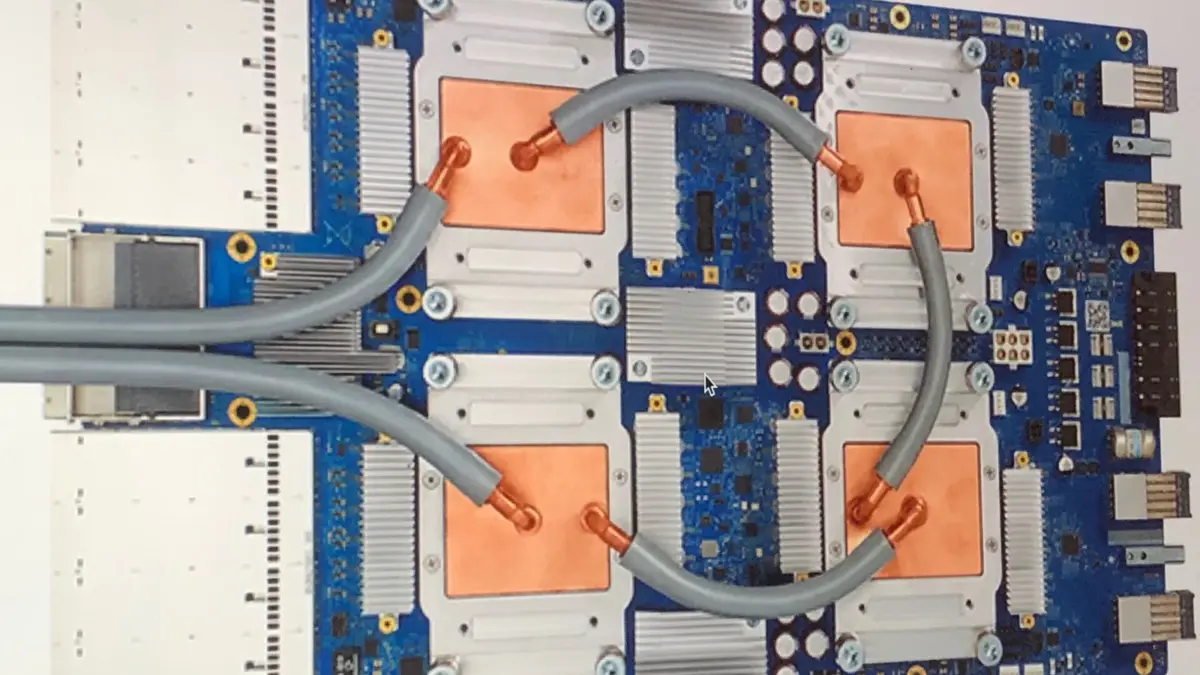
- Microsoft. In January 2026 Microsoft introduced Maia 200, an inference accelerator built on a 3-nanometre process, and began deploying it in US Azure regions.
Nvidia itself acknowledges the trend. “Some of our customers are developing their own ASICs and other products,” its quarterly report for the three months to April said, “including designs optimized for certain workloads that may not require all of the features and functionality our data center systems provide.”
None of this has yet cut Nvidia’s hyperscale sales, which more than doubled from a year earlier. The effect shows at the margin. In the second quarter the AI Clouds, Industrial and Enterprise group added $8.1bn of revenue on the previous quarter, against $5.7bn from the hyperscalers. Our reading is that each internal chip that works also gives the hyperscalers more leverage on price.
Who gets help, and who does not
Nvidia’s filings draw a clear line between the two groups. “We expect our large cloud service provider customers and investment grade enterprises to continue to secure land, power, and shell commitments independently,” the latest quarterly report says. The support goes to the others.
Those others now carry a large share of Nvidia’s growth. Nvidia attributes the 25% sequential rise in AI Clouds, Industrial and Enterprise revenue to “AI natives, enterprises, and sovereign customers, as well as hyperscalers utilizing AI clouds”. So some hyperscaler demand reaches Nvidia indirectly, through smaller clouds that buy the chips and rent out the capacity.
Behind those sales sit the arrangements described in our line-by-line reading of Nvidia’s $530bn: $36bn of agreements to buy capacity the clouds cannot sell, $3.5bn of lease guarantees for AI cloud partners, and $105bn of guarantees for a single OpenAI campus in Ohio. Nvidia’s chief financial officer, Colette Kress, explained the logic in August. “Many are growing faster than their balance sheets and long-term credit profiles can support,” her commentary said of AI clouds and model makers.
Even the largest customers are getting credit of a kind. Nvidia’s receivables rose to 60 days of sales at the end of July from 45 days, which the company put down to “extended payment terms on large, multi-quarter agreements with certain investment-grade customers”.
The concentration underneath
The customer base is narrow. In the second quarter one direct customer accounted for 16% of Nvidia’s revenue; over the first half, three direct customers accounted for 16%, 15% and 13%. Nvidia also estimates that “one AI research and deployment company contributed a meaningful amount of our revenue by purchasing cloud services from our customers”, without naming it.
Put together, the picture is of a supplier whose biggest customers are building substitutes and whose fastest-growing customers depend on its support. Neither trend alone is alarming. Together they mean that a larger share of future revenue rests on Nvidia’s willingness to keep extending that support, and that willingness is what the new management now has to decide on.
What changes after Huang
Investors expect Nvidia under Kress to be more selective with new start-up investments, TechCrunch reported after the resignation, as we covered in Huang’s exit and the start-up funding gap. Andy Li of CreditSights told CNBC on 13 November that he expected “a lot of this creative deal-making and circular financing and equity and credit support is going to moderate”.
If support does slow, the first effect would fall on the AI Clouds, Industrial and Enterprise group, the one that has been growing fastest. The hyperscalers would keep buying, on harder terms and with more of their own silicon in the mix.
What it means for founders and investors
For founders who rent compute, the shift to custom chips is good news over time. More silicon from more suppliers means more capacity and more pressure on GPU rental prices. Teams that keep their software portable across Nvidia, TPU and Trainium will be able to take advantage of it. Teams locked to a single provider’s capacity will not.
For neocloud founders and their investors, the question is sharper. A business that buys Nvidia systems, leases them out and borrows against the contracts depends on two things Nvidia controls: supply and support. With the hyperscalers less dependent on Nvidia, the smaller clouds have become Nvidia’s most important channel for growth. That gives them some bargaining power, but only as long as Nvidia’s new management wants the growth more than it fears the commitments. Our reports on neoclouds and the bond market and on Nscale’s financing needs show how thin the margin already is.
For investors in listed AI stocks, the mix line in Nvidia’s results is worth more attention than the headline revenue. A quarter in which the supported group keeps outgrowing the hyperscalers is a quarter in which Nvidia’s growth depends more on its own balance sheet. See what to watch on 17 November and how the arrangements compare with Lucent in 2000.
Sources: NVIDIA, CFO Commentary on Second Quarter Fiscal 2027 Results, 26 August 2026; NVIDIA, Form 10-Q for the quarter ended 26 July 2026 and for the quarter ended 26 April 2026 (risk factors); Anthropic, “Expanding our use of Google Cloud TPUs and services”, 23 October 2025; Amazon, “Trainium3 UltraServers now available”, 2 December 2025; Microsoft, introduction of Maia 200, 26 January 2026; The Information, as reported by Reuters, on Meta renting Google TPUs, February 2026; CNBC, “What’s ahead for AI financing after Nvidia CEO Jensen Huang departs”, 13 November 2026.
Nothing in this article is investment advice.