Intel shares fell by roughly 29% on Friday 30 October, their worst day since the 1970s according to CNBC, after the chipmaker gave a fourth-quarter outlook well below what analysts had pencilled in. TechCrunch, which put the drop at about 28%, noted that the move cut roughly $12bn from the value of the US government’s 10% stake.
The guidance that spooked the market
Intel’s own results release shows a company that, on its third quarter, did what it said it would. Revenue was $16.5bn, up 21% on a year earlier, and sales in its data centre and AI unit rose 78%, which the company called its strongest growth in that business in 15 years.
The problem was the next three months. Intel guided fourth-quarter revenue to $15bn–$16bn and gross margin to 37.1% on a GAAP basis, down from 43.0% in the third quarter. CNBC reported that analysts had expected revenue of about $17.1bn and adjusted earnings of 43 cents per share; Intel guided to 25 cents.
Chief executive Lip-Bu Tan pointed to demand for PCs. As quoted by TechCrunch, he said customers had begun to signal a slowdown because of memory prices and availability. AI data centres are absorbing a large share of memory and other components, which pushes up the cost of laptops and desktops. Finance chief David Zinsner told investors, in CNBC’s account, that the company expects the PC slowdown to continue at least through the first half of next year. CNBC also reported that an explosion at Intel’s fab in Israel earlier this month will cost about $600m in lost revenue over two quarters.
The state as shareholder
The US government has held about 10% of Intel since August 2025, which made Friday’s fall unusually public. Reuters, as cited by CNBC, put the paper loss at nearly $12bn, and CNBC reported that Nvidia, which also owns a stake, lost about $6bn. Even after the drop, TechCrunch noted, the government’s holding remains well above what it paid.
Friday was a bad session across the sector. CNBC said the Nasdaq Composite fell 2.9%, with Nvidia down 4%, Broadcom down 5% and Qualcomm down 11%.
Why it matters from London or Brussels
For European investors, the first lesson is concentration. Intel sits in many global equity funds and in the pension and sovereign portfolios that track them, so a one-day fall of this size lands in portfolios far from Santa Clara. The second is the link between AI demand and ordinary hardware. Money flowing into AI infrastructure is raising prices for the memory that PCs need, and that squeeze can hit device makers and the software firms that sell to PC buyers. That is our reading of the sources, not a claim made in them.
For founders, the split inside Intel’s own numbers is worth noting. Server and AI demand is strong, but the company says it is limited by how much it can supply. Start-ups building on server-class chips may find capacity tight for longer than they plan for.
What to watch
- Whether memory prices ease, which would be the first sign the PC slowdown is short-lived.
- Intel’s progress on freeing up extra supply for its server processors.
- Whether other chip companies repeat the PC warning in their own outlooks.
- Any statement from the US government about its stake after the fall.
Sources
- TechCrunch, “Intel’s stock crashes, knocking $12B from government’s stake” (30 October 2026)
- CNBC, Intel’s worst day since the 1970s and the effect on the government’s stake (30 October 2026)
- Intel Corporation, third-quarter 2026 earnings release (SEC filing)
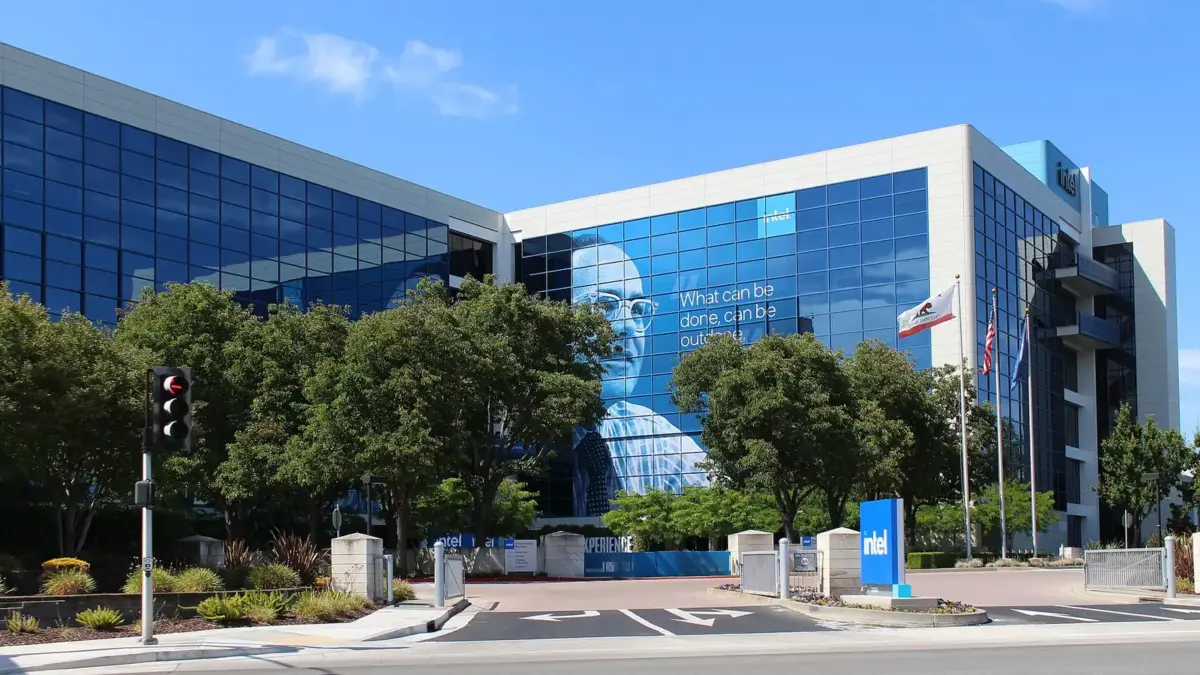
Photo: Intel headquarters in Santa Clara, by Coolcaesar, CC BY-SA 4.0, via Wikimedia Commons.